Performance of optical fibers birefringence and its effect on wavelength
DOI:
https://doi.org/10.59190/stc.v6i2.321Keywords:
Birefringence, Optical Fiber, Polarization, Refractive Index, WavelengthAbstract
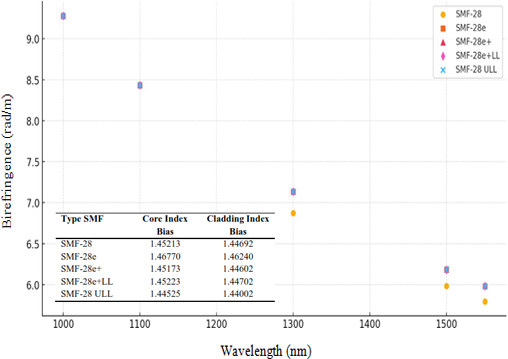
The phenomenon of refractive index difference between two orthogonal polarization modes in optical fibers, plays as an important role in optics transmission systems and precision sensors. This study aims to analyze the effect of wavelength on the birefringence performance of five types of single-mode optical fibers, namely SMF-28, SMF-28e, SMF-28e+, SMF-28e+LL, and SMF-28 ULL. Simulations were performed using OptiFiber software with wavelengths varying from 1000 nm to 1550 nm. The results show that the birefringence value decreases significantly as the wavelength increases, in line with the propagation of the optical field into the sleeve which reduces the refractive index difference between the two orthogonal modes. The highest birefringence value was recorded for SMF-28e+ at 9.28 rad/m 1000 nm, while the lowest value was 5.79 rad/m 1550 nm. In addition, external effects such as fiber curvature showed a contribution to the change in birefringence, which is relevant for the design of precision optical systems. These findings confirm the importance of controlling wavelength parameters and geometric structure in optimizing fiber birefringence performance for polarization- based optical communication and sensor applications. Suggestions for further research is to evaluate the effect of temperature, external pressure, and voltage on birefringence in various other types of optics fibers.
Downloads
Published
How to Cite
Issue
Section
License
Copyright (c) 2026 Nadia Rahayu, Fatima Nur Ramadhani

This work is licensed under a Creative Commons Attribution 4.0 International License.