Enhanced social media phishing detection model using LSTM and BERT
DOI:
https://doi.org/10.59190/stc.v6i2.360Keywords:
BERT, Cybersecurity, Deep Learning, Phishing Detection, Transfer LearningAbstract
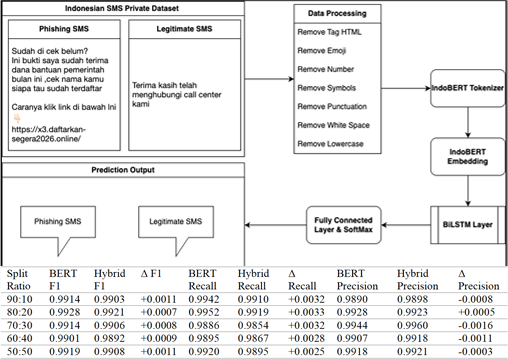
Phishing attacks are a major cyber threat, with more than 30% of incidents occurring via social media platforms, especially short message services. This study evaluates deep learning approaches for automated phishing detection using BERT and Hybrid (BERT-LSTM) architectures fine-tuned on 15950 annotated SMS. The BERT-only model achieved superior performance (F1 0.9928, recall 0.9952, AUC 0.999) with no statistically significant improvement from adding BiLSTM layers (0.0006). K-fold cross-validation demonstrated robust generalisation (coefficient of variation 0.10%). Dataset saturation analysis indicated that 15,950 SMS are sufficient for effective transfer learning. Mild overfitting (6.3x loss ratio) remained within acceptable bounds and did not affect validation metrics. The 1.77% false positive rate and 99.52% recall enable practical deployment for production phishing defence. Results demonstrate that transfer learning with BERT achieves production-grade performance while challenging conventional assumptions about architectural complexity.
Downloads
Published
How to Cite
Issue
Section
License
Copyright (c) 2026 Wenni Syafitri, Eddisyah Putra Pane, Edi Purwanto

This work is licensed under a Creative Commons Attribution 4.0 International License.