Systematic literature review using deep learning in plant genomic prediction
DOI:
https://doi.org/10.59190/stc.v6i3.368Keywords:
Crops, Deep Learning, Genomic Prediction, Plant Breeding, Systematic LiteratureAbstract
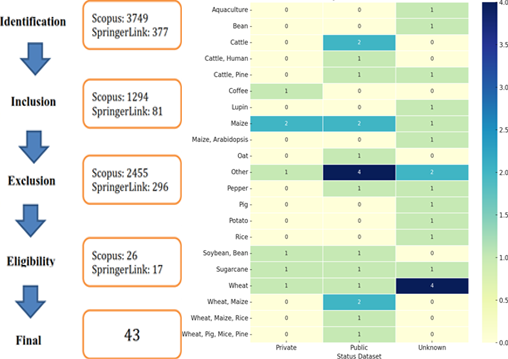
Genomic prediction (GP) is a critical approach in plant breeding used to forecast agronomic traits based on genetic marker data. In recent years, machine learning and deep learning methods have been increasingly applied in genomic prediction to address the limitations of traditional methods such as genomic best linear unbiased prediction (GBLUP). This systematic literature review aims to evaluate research trends over the past decade (2015–2025) regarding the application of deep learning in genomic prediction for crops, encompassing publication trends, publication sources, dataset types, key research topics, methods/algorithms used, implementation schemes, and commonly used evaluation metrics. The study follows the PRISMA protocol, with literature searches conducted on the primary databases Scopus and SpringerLink. From thousands of identified articles, 43 studies meeting the inclusion criteria were selected. The data revealed a significant increase in publications since 2018, peaking in 2024. The majority of articles were published in open-access journals, with notable contributions in Frontiers in Plant Science, Scientific Reports, and G3. The research covers various crop types, including wheat, maize, rice, soybean, sugarcane, and others, with diverse deep learning schemes such as convolutional neural networks (CNN), Ensemble Stacking, and Multi-Task Learning, often compared to conventional methods. The synthesis indicates that deep learning frequently enhances the accuracy of genomic prediction, particularly for complex multi-environment or multi-trait data. However, in some cases, classical linear/Bayesian models remain competitive. The application of deep learning in plant genomic prediction is rapidly advancing and demonstrates significant potential for improving crop selection performance.
Downloads
Published
How to Cite
Issue
Section
License
Copyright (c) 2026 Rizki Darmawan

This work is licensed under a Creative Commons Attribution 4.0 International License.