Workflow reproducibility and observability layer for Tomofast-x gravity inversion experiments
DOI:
https://doi.org/10.59190/stc.v6i3.374Keywords:
Gravity Inversion, Provenance Tracking, Reproducible Workflows, Runtime Observability, Tomofast-xAbstract
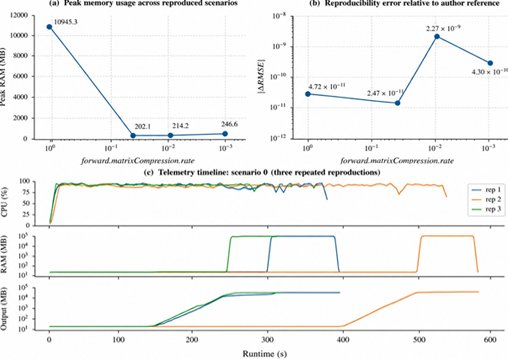
Tomofast-x is an open-source parallel platform for gravity and magnetic inversion; however, reproducible execution, runtime observability, and workflow traceability are commonly managed outside the inversion software itself. This study presented a provenance-aware and telemetry-aware experimentation environment for reproducible Tomofast-x workflows and evaluated it using four publicly available reference scenarios archived on Zenodo. Each scenario was reproduced three times, resulting in 12 platform-managed runs executed through isolated workspaces with structured provenance and telemetry collection. The reproduced solutions showed close agreement with the reference outputs, with mean absolute root mean square error differences ranging from approximately 2.47 × 10⁻¹¹ to 4.72 × 10⁻⁹. Runtime telemetry revealed substantial operational differences between scenarios. The uncompressed baseline required approximately 10.9 GB peak memory, whereas compressed scenarios required approximately 202 – 247 MB. Runtime decreased from approximately 436 s in the baseline case to approximately 300 – 340 s in compressed executions. Telemetry was successfully collected for all runs, including processor utilization, observed process-level RAM, runtime progression, and message passing interface (MPI) worker activity. Workflow robustness was further evaluated using injected failure cases involving corrupted parameter files, missing data grids, invalid execution paths, and simulated MPI failures. The results demonstrated that the proposed platform provided reproducible, provenance-aware, and telemetry-aware experimentation support for workstation-scale Tomofast-x workflows.
Downloads
Published
How to Cite
Issue
Section
License
Copyright (c) 2026 I Wayan Pio Pratama

This work is licensed under a Creative Commons Attribution 4.0 International License.