Predicting consumer loyalty from e-commerce reviews using emotion loyalty index with machine learning
DOI:
https://doi.org/10.59190/stc.v6i3.396Keywords:
Consumer loyalty, E-Commerce Reviews, Emotion-Loyalty Index, Machine Learning, Sentiment AnalysisAbstract
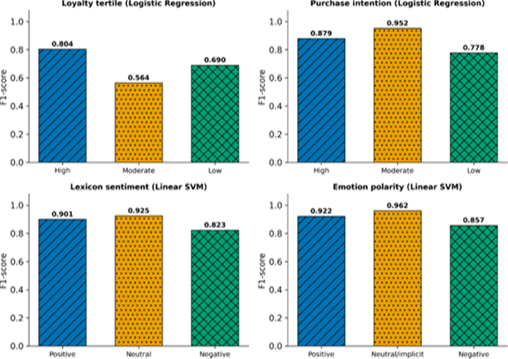
Customer reviews provide ratings and affective text, yet conventional sentiment classification and rating prediction do not offer a transparent multidimensional measure of consumer loyalty across e-commerce platforms. This study aimed to construct and evaluate a review-based emotion-loyalty index (ELI) for Shopee, Tokopedia, Lazada, Blibli, and Bukalapak. A quantitative computational design combined six formative components: normalized rating, lexicon sentiment, positive emotion, negative emotion, recommendation signals, and seller responses within a bounded 0-1 score. Reviews were preprocessed and represented using TF-IDF; corpus size was not reported in the supplied documents. Platform differences were examined descriptively, while Naive Bayes, Random Forest, Linear SVM, and Logistic Regression were evaluated on holdout data using accuracy and class-level F1. Blibli achieved the highest mean ELI of 0.363 and high-loyalty share of 53.8%, whereas Bukalapak recorded 0.254 and 24.9%, producing gaps of 0.109 and 28.9 percentage points. Tokopedia, Shopee, and Lazada obtained mean ELI values of 0.359, 0.336, and 0.317. Linear SVM reached 94.3% accuracy for emotion polarity, 93.6% for purchase intention, and 90.6% for lexicon sentiment, while Logistic Regression achieved 68.5% for loyalty tertiles. The proposed ELI contributes an interpretable framework that integrates evaluation, affect, advocacy, and seller engagement while separating platform comparison from leakage-controlled prediction. The framework can support platform diagnostics and targeted loyalty interventions across competitive digital marketplaces in Indonesia and comparable emerging economies, although future validation requires a timestamped corpus, complete inferential statistics, alternative weighting schemes, and longitudinal behavioral outcomes.
Downloads
Published
How to Cite
Issue
Section
License
Copyright (c) 2026 Midrawati Hasibuan, Jeni Sukmal, Selamat Subagio

This work is licensed under a Creative Commons Attribution 4.0 International License.