Concrete bricks substituted with fly ash, PET (polyethylene terephthalate) plastic waste, and rice husk ash
DOI:
https://doi.org/10.59190/stc.v7i1.423Keywords:
Compressive Strength, Concrete Brick, Fly Ash, PET Plastic, Rice Husk AshAbstract
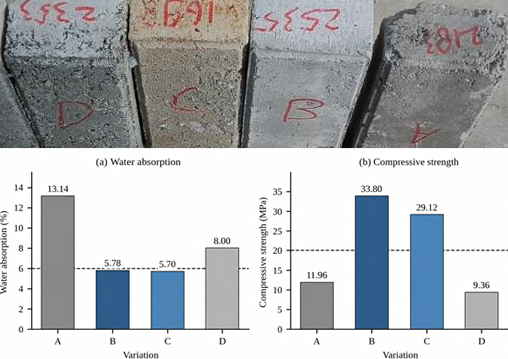
Polyethylene terephthalate (PET) plastic waste, fly ash, and rice husk ash are still underused. This study examined how combining the three substitute materials affects the compressive strength and water absorption of concrete bricks, and compared three ways of distributing PET in the mix. In a quantitative laboratory experiment, four mixes with a constant water-cement ratio of 0.25 were made: a control without waste (variation A), PET mixed evenly (variation B), PET placed in the center (variation C), and PET placed in the center under heavy compaction (variation D). Variations B, C, and D contain 200 g of PET, 100 g of fly ash, and 50 g of rice husk ash, with cement reduced by 20% and sand by 25%. Bricks measuring 20 × 10 × 6 cm3 were cured for 28 days and tested following SNI 03-0691-1996. Variation B performed best, with a compressive strength of 33.80 MPa and water absorption of 5.78%, while the control reached only 11.96 MPa and 13.14%. Variation C gave 29.12 MPa and 5.70%. Variation D fell to 9.36 MPa and 8.00% because of the heavy compaction. Only variations B and C meet the quality requirements for concrete bricks. A preliminary cost estimate puts production about 11% below that of conventional bricks. Evenly distributed PET appears to be the key to turning these wastes into strong, sustainable concrete bricks.
Downloads
Published
How to Cite
Issue
Section
License
Copyright (c) 2026 Nana Misrochah

This work is licensed under a Creative Commons Attribution 4.0 International License.