Unsupervised federated autoencoders for IoT botnet detection under non-IID and contaminated training data
DOI:
https://doi.org/10.59190/stc.v7i1.424Keywords:
Autoencoder, Botnet Detection, Federated Learning, Internet of Things, Non-IID DataAbstract
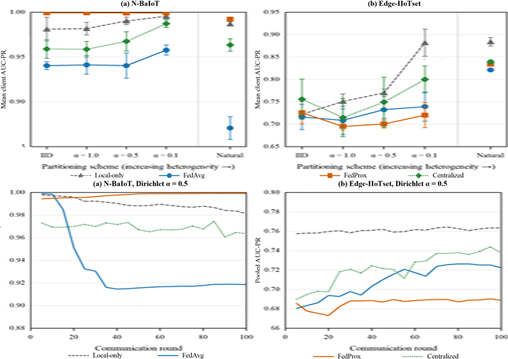
Federated learning (FL) has been proposed for privacy-preserving intrusion detection in internet of things (IoT) networks, yet most studies assumed labeled traffic and identically distributed client data. This study benchmarked unsupervised federated autoencoders for IoT botnet detection under non-IID heterogeneity and training-data contamination. N-BaIoT and Edge-IIoTset were partitioned into clients using IID, natural per-device, and Dirichlet partitions with concentration parameters of 1.0, 0.5, and 0.1, and botnet traffic was injected into the benign training data of 30% of the clients at rates of 0% – 20%. Lightweight autoencoders were trained on unlabeled traffic and aggregated with FedAvg and FedProx, with local-only and centralized training as references, in 264 runs over five random seeds. FedAvg did not outperform local-only training in any of the ten dataset–partition settings (mean AUC-PR difference of 0.058, Holm-adjusted p = 0.014) and, on N-BaIoT, declined by up to 0.087 after an early peak. FedProx prevented this decline on N-BaIoT (AUC-PR up to 0.999) but gave no gain on Edge-IIoTset. Under heterogeneity, a single global threshold raised the false positive rate from about 1% to 22.2%, whereas client-level thresholds kept it at or below 1.0%. Contamination of 20% reduced the worst-client F1-score by 0.33 for FedAvg and 0.47 for FedProx, and client-level thresholds did not recover this loss. These findings indicated that standard aggregation and a single global threshold were insufficient for unsupervised federated botnet detection and motivated label-free, heterogeneity-aware aggregation with client-level threshold calibration.
Published
How to Cite
Issue
Section
License
Copyright (c) 2026 Muhammad Ikhsan, Imam Riadi, Ardiansyah Ardiansyah

This work is licensed under a Creative Commons Attribution 4.0 International License.