Implementation of U-Net as EfficientNet encoder for brain tumour type classification
DOI:
https://doi.org/10.59190/stc.v6i3.387Keywords:
Brain Tumour, EfficientNet, Encoder, Image Classification, U-NetAbstract
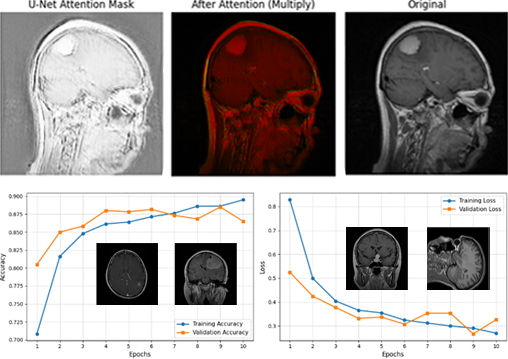
Brain tumor is one of the most dangerous diseases that requires fast and accurate diagnosis to support patient diagnose. The application of deep learning on magnetic resonance imaging (MRI) images has been widely used to assist automatic brain tumor classification. This study aims to implement a hybrid U-Net encoder-EfficientNet architecture for brain tumor classification using MRI images. In this study, the U-Net encoder was utilized to extract spatial features and generate an attention mask to highlight important regions before the classification process was performed by EfficientNet-B0. The dataset used was BRISC 2025, consisting of 6,000 MRI images divided into four classes: glioma, meningioma, pituitary, and no tumor. The experiments were conducted using three data splitting scenarios, namely 60:20:20, 70:15:15, and 80:10:10. The results showed that the proposed model achieved good classification performance across all testing scenarios. In the 60:20:20 scenario, the model achieved an accuracy of 82%, precision of 0.83, recall of 0.82, and F1-score of 0.81. In the 70:15:15 scenario, the model achieved an accuracy of 84%, precision of 0.85, recall of 0.84, and F1-score of 0.83. Meanwhile, the 80:10:10 scenario produced the best performance with an accuracy of 85%, precision of 0.86, recall of 0.85, and F1-score of 0.84. These results indicate that the use of the U-Net encoder was able to help the model focus on tumor regions, thereby improving the effectiveness of the classification process.
Downloads
Published
How to Cite
Issue
Section
License
Copyright (c) 2026 Rahma Aulia, Junadhi Junadhi, Lusiana Efrizoni, Rini Yanti

This work is licensed under a Creative Commons Attribution 4.0 International License.