Comparative evaluation of PCA-based feature extraction and chi-square feature selection for student burnout classification using support vector machine
DOI:
https://doi.org/10.59190/stc.v6i3.401Keywords:
Chi-Square, Feature Engineering, Principal Component, Student Depression, Support Vector MachineAbstract
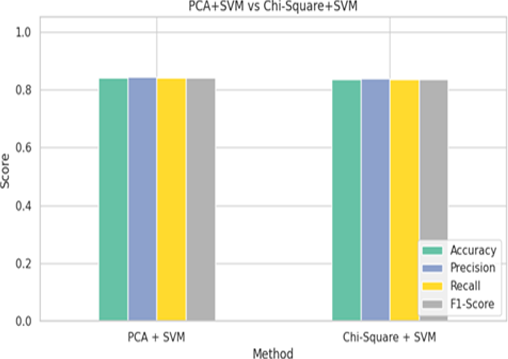
Student depression has emerged as a critical mental health issue that adversely affects academic performance, psychological well-being, and quality of life. Early identification of depression risk is essential to enable timely intervention and effective mental health management. This study compares the effectiveness of two feature engineering techniques, principal component analysis (PCA)-based feature extraction and chi-square feature selection, for student depression classification using support vector machine (SVM). The experiments employed the student depression dataset from Kaggle, containing demographic, academic, lifestyle, and psychological attributes. Data preprocessing included data cleaning, label encoding, and feature scaling before feature engineering and classification. PCA was applied to reduce feature dimensionality while preserving the maximum data variance, whereas chi-square selected the most relevant features based on statistical significance. Model performance was evaluated using accuracy, precision, recall, and F1-score. The results demonstrate that PCA consistently outperformed chi-square feature selection. The PCA–SVM model achieved an accuracy of 84.09%, precision of 84.24%, recall of 84.09%, and F1-score of 84.14%, compared with 83.61%, 83.75%, 83.61%, and 83.65%, respectively, for the chi-square–SVM model. These findings indicate that PCA is more effective in reducing feature redundancy while preserving informative patterns, resulting in improved classification performance. Therefore, PCA-based feature extraction is a more suitable feature engineering approach for SVM-based student depression classification and offers a promising solution for intelligent early mental health screening in higher education.
Downloads
Published
How to Cite
Issue
Section
License
Copyright (c) 2026 Mira Salmira, Junadhi Junadhi, Rahmiati Rahmiati, Triyani Arita Fitri

This work is licensed under a Creative Commons Attribution 4.0 International License.