Application of recursive feature elimination for sex classification of skull bones using random forest
DOI:
https://doi.org/10.59190/stc.v6i3.390Keywords:
Craniometry, Feature Selection, Forensic Anthropology, Machine Learning, Sexual DimorphismAbstract
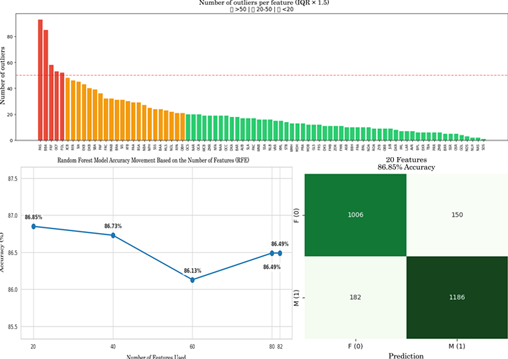
In forensic anthropology, sex estimation from the skull was a crucial initial step when visual identification of a body was not possible. Conventional methods relied on morphological assessment by experts, which was inherently subjective and dependent on the observer's experience. To address this limitation, this study implemented a computational approach using the random forest algorithm combined with the Recursive Feature Elimination feature-selection technique. The approach was evaluated using craniometric measurements from 2,524 individuals, comprising 1,368 males and 1,156 females, sourced from the Howell's craniometric dataset. The main challenge was the high dimensionality of the data, comprising 85 measurement features after non-biological attributes were removed. Using an excessive number of variables simultaneously introduced irrelevant information that lowered the model's ability to recognize true patterns, so the feature-selection technique was used to iteratively select the most informative measurements. The results showed that the model using all 82 features achieved an accuracy of 86.49 percent, while the optimized model using only 20 selected features achieved a higher accuracy of 86.85 percent. This indicated that by reducing the feature set by 75 percent, the model became lighter while remaining more accurate. The selection process further identified that cheekbone width and the height of the posterior ear protrusion were the most discriminative measurements between male and female crania, consistent with established biological evidence. In conclusion, the combination of random forest and recursive feature elimination produced an efficient and accurate sex-identification model, opening opportunities for its development as an objective forensic identification tool in the future.
Downloads
Published
How to Cite
Issue
Section
License
Copyright (c) 2026 Zam Afryan, Iwan Iskandar, Iis Afrianty, Benny Sukma Negara, Fadhilah Syafria

This work is licensed under a Creative Commons Attribution 4.0 International License.