Characterizing alpha-band electroencephalography activity from cognitive listening test in undergraduate students
DOI:
https://doi.org/10.59190/stc.v7i1.415Keywords:
Cognitive-Listening-Test, Electroencephalography, Alpha Frequency, Power Spectral Density, Periodogram WelchAbstract
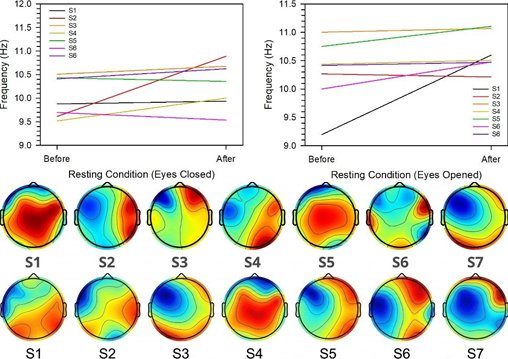
This study examined alpha-band electroencephalography (EEG) activity during a cognitive listening test in undergraduate students aged 19 – 22 years. EEG signals were recorded using an EMOTIV EPOC+ device during resting-state conditions and a listening-based cognitive test involving synonyms, antonyms, word analogies, premise-based reasoning, and narrative-audio comprehension tasks. Alpha-band power spectral density (PSD) was estimated using Welch's periodogram method to describe the magnitude and scalp distribution of alpha-band activity in seven undergraduate students (aged 19 – 22 years) during resting state and cognitive task condition. The resting-state results showed consistently higher alpha PSD during eyes-closed than eyes-open conditions, both before and after the cognitive listening test. During task performance, scalp topographies showed substantial inter-individual variation in the magnitude and spatial distribution of alpha band PSD. This descriptive pattern cannot be attributed to specific cognitive processes or strategies because behavioral measures and inferential statistics were not available. The findings indicate that Welch based PSD analysis can be used to describe EEG activity during listening tasks, larger samples, behavioral measures, artifact correction, and statistical comparisons are required before any EEG markers of listening performance can be proposed.
Published
How to Cite
Issue
Section
License
Copyright (c) 2026 Feby Nur Sakinah, Zulfa Zulfa, Yuanita Puspita Dewi Sudarso, Siti Nurul Khotimah

This work is licensed under a Creative Commons Attribution 4.0 International License.