Analysis of the effect of mechanical bending on the optical power of Bragg grating optical fibers in thermal measurements
DOI:
https://doi.org/10.59190/stc.v7i1.353Keywords:
Fiber Bragg Grating, Mechanical Bending, Optical Power, Temperature Sensing, Thermal ResponseAbstract
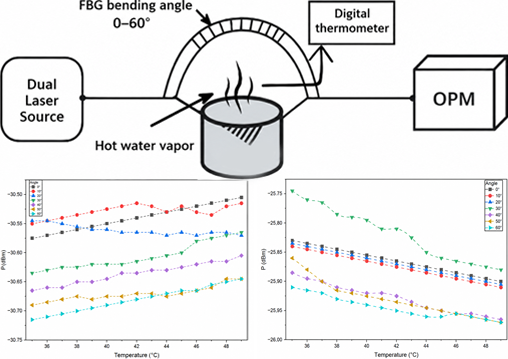
Bending of optical fibers is employed as a control parameter to evaluate the thermo-mechanical sensitivity and response of fiber Bragg grating (FBG) sensors in temperature measurements on curved structures. A uniform FBG is operated at two wavelengths, 1310 nm and 1550 nm, with bending angles from 0° to 60° and exposure to hot water vapor within a temperature range of 35°C – 49°C. The output power is measured using an optical power meter (OPM), and the Bragg wavelength shift is obtained from the transmission response. At 1550 nm, the transmitted power decreases from -25.83 dBm (0°) to -25.97 dBm (60°), accompanied by increased Bragg wavelength shifts at larger angles and higher temperatures. In contrast, at 1310 nm, the power variation is smaller (-30.57 dBm to -30.71 dBm), and Bragg wavelength remains almost unchanged at lower temperatures, with oscillations becoming noticeable only at larger bending angles. The 0° – 20° range exhibits the most stable response, whereas the 40°– 60° range at 1550 nm demonstrates the highest sensitivity to temperature variations. Overall, operation at 1550 nm is more responsive to thermomechanical effects, while 1310 nm exhibits greater stability against fiber bending.
Published
How to Cite
Issue
Section
License
Copyright (c) 2026 Wardah Azizah Matondang, Saktioto Saktioto

This work is licensed under a Creative Commons Attribution 4.0 International License.