Apodization profiles of fiber Bragg grating spectra in temperature sensor applications
DOI:
https://doi.org/10.59190/stc.v6i3.383Keywords:
Apodization, Fiber Bragg Grating, Side Lobe, Simulation, Temperature SensorAbstract
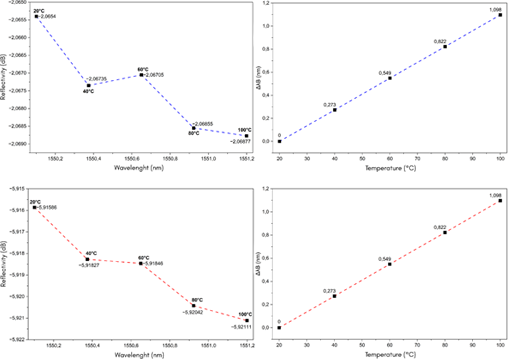
The presence of side lobes in the FBG reflection spectrum is a critical challenge that can reduce measurement accuracy in optical sensor applications, necessitating a systematic evaluation of apodization techniques as a mitigation strategy. This study investigated the comparative effects of three apodization profiles, namely uniform, Gaussian, and tanh hyperbolic, on the spectral characteristics and performance of an sensors-based temperature sensor with a grating length of 10 mm, grating period of 0.535 µm, modulation index of 0.0001, and operating wavelength of 1550 nm, over a temperature range of 20°C to 100°C. The results showed that all three profiles produced an identical thermal sensitivity of 13.725 pm/°C with a deviation of 3.23% from the theoretical value of 14.183 pm/°C. The Gaussian profile demonstrated the most superior side lobe suppression with an average side lobe level (SLL) of -45.51 dB, exceeding the minimum standard of -20 dB by more than 25 dB, far surpassing the uniform (-16.90 dB) and tanh (-18.17 dB) profiles. These findings establish the Gaussian apodization profile as the most optimal configuration, delivering the highest spectral quality without compromising thermal sensitivity.
Published
How to Cite
Issue
Section
License
Copyright (c) 2026 Septia Putri Ayu, Saktioto Saktioto, Rakhmawati Farma, Rahmondia Nanda Setiadi, Haryana Mohd Hairi

This work is licensed under a Creative Commons Attribution 4.0 International License.