Simulation Simulation and analysis of fiber Bragg grating for pulse strain monitoring using uniform and Gaussian apodization
DOI:
https://doi.org/10.59190/stc.v6i3.389Keywords:
Fiber Bragg Grating, Gaussian Apodization, Pulse Monitoring, Strain Sensor, Uniform ApodizationAbstract
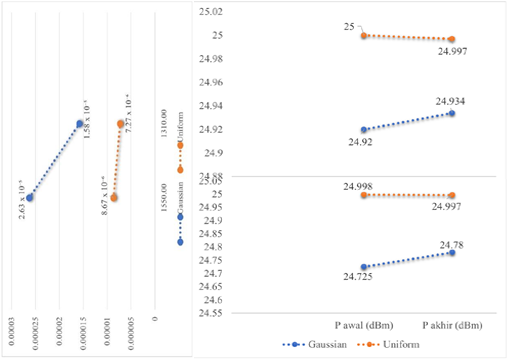
Fiber Bragg Grating (FBG) is a passive optical sensor capable of detecting strain through a shift in the Bragg wavelength. This study designed and simulated an FBG-based sensor system for pulse-strain monitoring using two apodization profiles, uniform and Gaussian, at operating wavelengths of 1310 nm and 1550 nm. The sensor system was designed using OptiGrating 4.2.2.69 and OptiSystem 11.1.0.53 software with a single circuit configuration consisting of four parallel FBGs. The optical fiber parameters used included a core diameter of 2 µm, a cladding diameter of 8 µm, core refractive indices of 1.4600 and 1.4605, and a grating length of 10000 µm. The OptiGrating simulation results show that Gaussian apodization produces a cleaner reflection spectrum with lower sidelobes (around -60 dB) compared to uniform apodization, which exhibits higher and broader sidelobes (around -40 dB). In the OptiSystem analysis using an optical spectrum analyzer (OSA) at 1310 nm, Gaussian apodization yields an initial power of 24.920 dBm and a final power of 24.934 dBm, while uniform apodization yields an initial power of 25.000 dBm and a final power of 24.997 dBm. At 1550 nm, Gaussian produced an initial power of 24.725 dBm and a final power of 24.780 dBm, while uniform produced 24.998 dBm and 24.992 dBm, respectively. The strain value for both apodizations was calculated from the Bragg wavelength shift equation, yielding sensitivities of approximately 1.21 pm/µstrain at 1550 nm and 1.02 pm/µstrain at 1310 nm, consistent with theoretical FBG sensitivity. Optical power meter (OPM) measurements supported the OSA results with consistent power variations, and oscilloscope analysis showed stable signals for both apodizations, with uniform displaying slightly higher and more consistent amplitude. Uniform apodization excels in reflectance and amplitude stability, while Gaussian apodization excels in spectral quality with lower sidelobes and a higher strain-detection sensitivity that falls within the normal physiological pulse-strain range (10 – 50 µstrain). The choice of apodization therefore depends on the priority requirements of the strain-sensor application.
Published
How to Cite
Issue
Section
License
Copyright (c) 2026 Amiroh Hasanah Yellis, Saktioto Saktioto, Erwin Amiruddin, Defrianto Defrianto, Hewa Yaseen Abdullah

This work is licensed under a Creative Commons Attribution 4.0 International License.