Forensic identification of adulterated petroleum fuels (diesel, Pertalite, and Pertamax) through GC-MS fingerprinting and physicochemical analysis
DOI:
https://doi.org/10.59190/stc.v7i1.442Keywords:
Flash Point, Fuel Adulteration, GC-MS, Pertalite, PertamaxAbstract
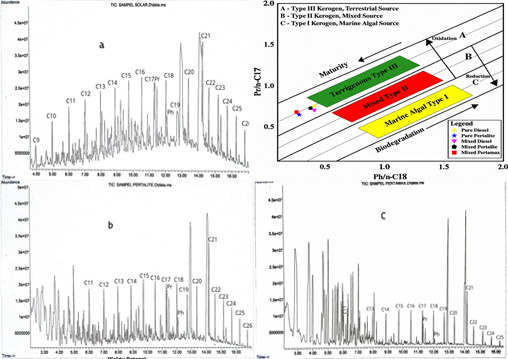
A Fuel adulteration is a form of petroleum product fraud that can cause significant economic losses to consumers and adversely affect vehicle engine performance. This study aims to investigate the chemical composition and determine the characteristics of adulterated diesel, Pertalite, and Pertamax fuels. A qualitative analytical approach was employed by comparing adulterated fuel samples with their corresponding unadulterated counterparts. Gas chromatography-mass spectrometry (GC-MS) was used to identify the chemical constituents, while flash point and viscosity measurements were performed to evaluate their physicochemical properties. The GC-MS results revealed variations in alkane chain distributions and the presence of sulfur-containing compounds, aromatic hydrocarbons, naphthalene, and benzene derivatives. The identified hydrocarbon profiles indicated the presence of kerosene and diesel fuel components in the adulterated samples. Furthermore, the physicochemical characterization revealed differences in flash point and viscosity between pure and adulterated fuels. The reference flash point specifications for diesel, Pertalite, and Pertamax were 52°C, 23.5°C, and 27.5°C, respectively, while their corresponding viscosity specifications were 2 – 4.2 mPa·s, 0.4 – 0.6 mPa·s, and 0.5 – 0.7 mPa·s. In comparison, the measured flash points of the pure fuel samples were 52°C, 25.5°C, and 29.5°C, with corresponding viscosity values of 0.065 mPa·s, 0.725 mPa·s, and 0.675 mPa·s, respectively. The adulterated samples exhibited flash points of 74°C, 52°C, and 38°C, accompanied by viscosity values of 3.96 mPa·s, 4.45 mPa·s, and 10.16 mPa·s, respectively.
Published
How to Cite
Issue
Section
License
Copyright (c) 2026 Sofia Anita, M Zikri Arafi

This work is licensed under a Creative Commons Attribution 4.0 International License.