Design and characterization of a graphene-coated fiber Bragg grating gas sensor for low-concentration methane and carbon dioxide detection
DOI:
https://doi.org/10.59190/stc.v6i2.355Keywords:
Evanescent Field, Gas Adsorption, Graphene Coating, Optical Sensing, Wavelength ShiftAbstract
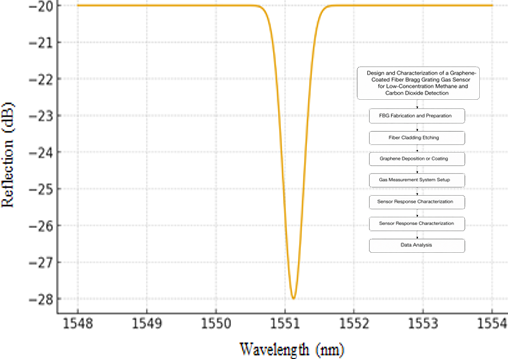
Early detection and accurate monitoring of methane (CH4) and carbon dioxide (CO2) at low concentrations are essential for industrial safety, environmental monitoring, and greenhouse gas mitigation. Conventional gas sensors, including electrochemical and semiconductor types, suffer from environmental sensitivity, frequent calibration needs, and limited long-term stability. Therefore, more stable, sensitive, and intrinsically safe sensing technologies are required, especially for high-risk environments. Fiber Bragg grating (FBG) sensors offer key advantages as passive optical devices that are immune to electromagnetic interference, compact, and capable of multiplexed operation. This study presents the design and characterization of a graphene-coated FBG sensor for low-concentration CH4 and CO2 detection. The FBG was fabricated using the phase mask technique, followed by cladding etching to enhance evanescent field interaction with the surrounding medium. A graphene layer was synthesized via chemical vapor deposition (CVD) and transferred onto the etched fiber surface to serve as the active sensing layer. Gas adsorption on graphene induces refractive index variations, producing measurable Bragg wavelength shifts monitored by a high-resolution optical interrogator. Experiments were conducted at concentrations up to 100 ppm under controlled temperature and humidity conditions. Results show sensitivities of 12.4 pm/100 ppm for CO2 and 9.7 pm/100 ppm for CH4, with strong linearity (R2 > 0.98), fast response time (< 15 s), low hysteresis, and good long-term stability. The proposed FBG-graphene sensor demonstrates strong potential for reliable real-time gas monitoring in industrial and environmental applications.
Downloads
Published
How to Cite
Issue
Section
License
Copyright (c) 2026 Dedi Irawan, Dwi Hanto, Bambang Widiyatmoko

This work is licensed under a Creative Commons Attribution 4.0 International License.