Identification of tenera and dura variety of oil palm fresh fruit bunches based on RGB color and fruit firmness
DOI:
https://doi.org/10.59190/stc.v6i3.381Keywords:
Computer Vision, Fruit Firmness, Oil Palm FFBs, RGB Intensity, VarietyAbstract
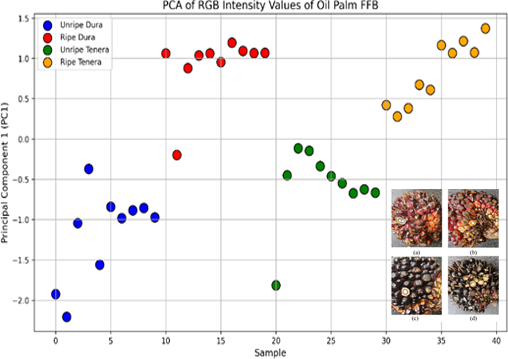
Sorting and grading oil palm fresh fruit bunches (FFBs) by variety in oil palm mills is destructive and inefficient, necessitating a more accurate, rapid, non-destructive approach. This preliminary study aims to develop a computer vision system to identify oil palm FFBs varieties (dura and tenera) using RGB intensities and fruit firmness levels. The study used 20 dura FFBs and 20 tenera FFBs, each with 10 ripe and 10 unripe FFBs, while fruit firmness was measured with a GY-3 needle-type penetrometer. Analysis of RGB intensities showed that ripe tenera had the highest values, while unripe dura had the lowest. In addition to RGB intensity analysis, this study also used principal component analysis (PCA) to visualize the separation patterns of varieties and ripeness levels based on RGB values. The PCA results showed that RGB intensity values clearly distinguished the dura and tenera groups in both ripe and unripe conditions. In terms of firmness, unripe fruits of both varieties had significantly higher firmness values than ripe fruits, with unripe dura showing the highest value of 12.5 kg/cm2 and ripe tenera showing the lowest value of 7.23 kg/cm2, indicating an inverse relationship between ripeness and fruit firmness. This study demonstrates that RGB intensities and fruit firmness levels can serve as potential parameters for distinguishing between the dura and tenera varieties in a computer-vision-based oil palm FFBs sorting system.
Downloads
Published
How to Cite
Issue
Section
License
Copyright (c) 2026 Melisa Zuliana, Minarni Shiddiq, Herman Syahdan, Farid Amanullah, Tiya Novita Sari, Mita Virdina, Ola Noviza, Vicky Vernando Dasta

This work is licensed under a Creative Commons Attribution 4.0 International License.