Data-driven segmentation of sharia-based SMEs digital readiness: Comparing K-means and fuzzy C-means for strategic transformation planning
DOI:
https://doi.org/10.59190/stc.v6i3.391Keywords:
Clustering, Digital Readiness, Fuzzy C-Means, K-Means, Sharia-Based SMEsAbstract
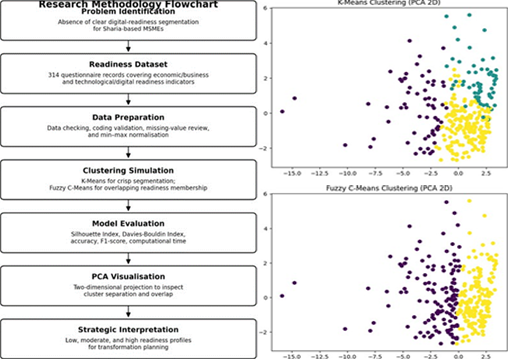
Quired to adopt digital technologies while preserving Islamic business principles such as transparency, fairness, trustworthiness, halal integrity, and ethical value creation. However, many sharia-based SMEs still lack clear diagnostic information regarding their digital readiness level, making it difficult for policymakers, business associations, and SMEs managers to design targeted digital transformation interventions. Prior studies on SMEs digitalisation have largely focused on technology adoption, digital marketing, or general readiness assessment, while limited attention has been given to data-driven segmentation models that can classify sharia-based SMEs into actionable readiness groups. Addressing this gap, this study compares K-means and Fuzzy C-means clustering to identify digital readiness patterns among sharia-based SMEs. The dataset consists of 314 SMES records collected through questionnaires and structured into two main perspectives, includes economic/business readiness and technological/digital readiness. The variables include business activity, transaction capability, management capability, market interaction, macro-environmental readiness, digital culture, digital education, financial resources, and technical infrastructure. Prior to clustering, the data were normalised to ensure comparability across indicators. K-means was used as a hard clustering benchmark because of its computational simplicity and ability to produce clear readiness groups, while Fuzzy C-means was applied as a soft clustering method because SMEs readiness boundaries are often overlapping and gradual rather than strictly separated. The clustering process was designed to generate three readiness categories viz., low, moderate, and high digital readiness. Model evaluation was conducted using silhouette index, Davies–Bouldin index, accuracy, F1-score, computational stability, and principal component analysis-based visualisation. The results show a trade-off between cluster separation quality and classification-oriented performance. Fuzzy C-means achieved a higher silhouette index of 0.1362 and a lower Davies–Bouldin index of 2.6126, indicating better internal cluster quality and stronger ability to represent overlapping readiness characteristics. In contrast, K-means produced higher accuracy of 0.6033 and F1-score of 0.3202, and more clearly formed three practical readiness categories. These findings suggest that Fuzzy C-means is more suitable for exploratory readiness profiling where SMEs may belong partially to more than one readiness stage, whereas K-means is more useful for managerial decision-making requiring crisp classification into low, moderate, and high readiness groups. This study contributes to SMEs digital transformation literature by demonstrating that sharia-based digital readiness should be analysed not only through aggregate scores, but also through segmentation models that reveal heterogeneous readiness patterns. Practically, the proposed comparative clustering framework provides a diagnostic basis for policymakers, Islamic business institutions, and SMEs development agencies to design differentiated digital capability-building programmes.
Downloads
Published
How to Cite
Issue
Section
License
Copyright (c) 2026 Ananda Vermiansyah, Okfalisa Okfalisa, Rahmad Abdillah, Surya Agustian, Zahidah Zulkifli, Taofeeq Durojaye Moshood

This work is licensed under a Creative Commons Attribution 4.0 International License.