The impact of ADASYN on Alzheimer's disease classification performance using backpropagation neural networks
DOI:
https://doi.org/10.59190/stc.v7i1.438Keywords:
ADASYN, Alzheimer's Disease, BPNN, Classification, Machine LearningAbstract
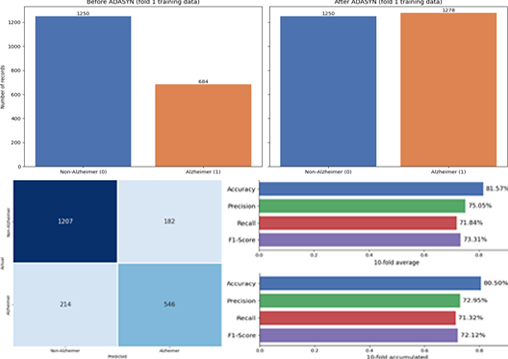
Alzheimer's disease (AD) is a neurodegenerative disorder that causes a decline in cognitive ability and the capacity to perform daily activities. Class imbalance in Alzheimer's data may bias machine learning models toward the majority class and reduce their ability to recognize the minority class. This study applied adaptive synthetic sampling (ADASYN) to a backpropagation neural network (BPNN) to balance the class distribution and improve the classification of Alzheimer’s disease. The Kaggle dataset contained 2,149 records (760 Alzheimer and 1,389 non-Alzheimer) with 34 input variables, which were reduced to 32 after selection, and one binary output variable. After preprocessing, the data were split using 10-fold cross-validation. Z-score normalization and ADASYN were applied to the training data of each fold, whereas the test data received only Z-score normalization. The 32-33-1, 32-48-1, and 32-63-1 architectures were evaluated with learning rates of 0.01, 0.05, and 0.09, each with and without ADASYN. The 10-fold average results showed that ADASYN consistently improve neither accuracy (80.47% with ADASYN versus 80.41% without) nor recall, which was higher in only 2 of 9 configurations (70.83% versus 72.28%). The best configuration was the 32-63-1 architecture with a learning rate of 0.01 and ADASYN, which achieved 81.57% accuracy, 75.05% precision, 71.84% recall, and 73.31% F1-score. ADASYN tended to reduce false positives but did not reduce undetected Alzheimer cases (false negatives) providing no better results for Alzheimer’s disease diagnosis.
Published
How to Cite
Issue
Section
License
Copyright (c) 2026 Alghozi Rafif Ali, Iis Afrianty, Pizaini Pizaini, Yusra Yusra, Nazruddin Safaat Harahap

This work is licensed under a Creative Commons Attribution 4.0 International License.